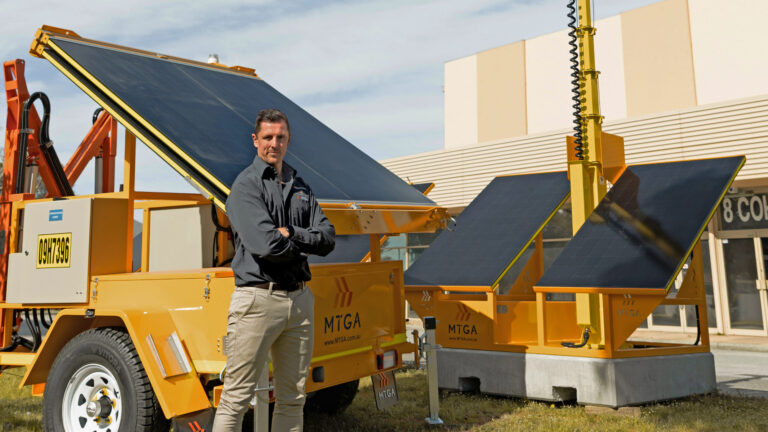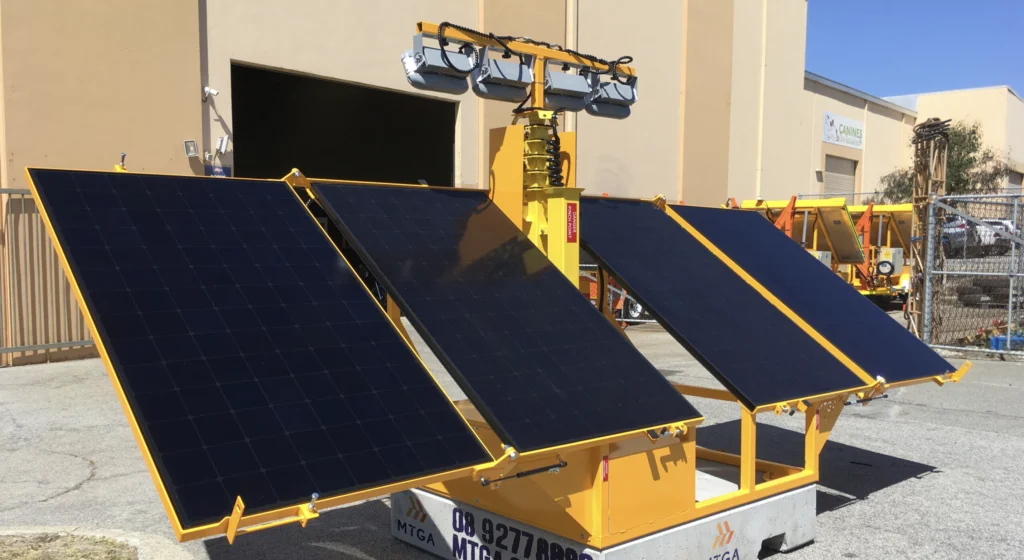
Diesel-free lighting towers are mobile lighting units that run on battery power instead of a diesel generator, with the batteries charged by solar panels or an external power source. With no engine on board, they save you fuel runs and refuelling, reduce engine noise and produce no on-site exhaust.
One type of diesel-free tower runs on solar, which is the approach behind every unit in our off-grid lighting range. These towers charge their batteries during the day and draw on them to run LED lights through the night. Not every diesel-free unit works this way, though, and each type can suit different construction sites.
What counts as a diesel-free lighting tower?
A lighting tower is diesel-free when nothing on board burns diesel at any point in its operation. That covers two types, solar towers and battery-only towers. Hybrid towers are often grouped with them, but they still carry a diesel generator, which makes them diesel-reduced rather than diesel-free.
- Solar lighting towers carry their own panels and battery bank, so they can stay on site and recharge without outside help. How long they run through cloudy stretches comes down to battery capacity and how much sun the panels get.
- Battery-only lighting towers have no panels or engine. Their batteries are charged from mains or another external source between uses, so they suit shorter deployments or sites where recharging is easy to organise.
- Hybrid lighting towers pair solar panels and batteries with a small diesel generator that takes over when the battery runs low. They burn less fuel than a standard diesel tower, but refuelling and engine servicing still need managing.
Diesel vs diesel-free lighting towers
Diesel towers still put out more light per unit and can run for two weeks or more between refuels on 12-hour shifts, which keeps them common on large sites.
Solar and battery-only towers give up some of that output in exchange for no fuel at the tower, no engine servicing and no exhaust. Solar towers recharge themselves each day, while battery-only towers need plugging in between uses.
| Diesel LED tower | Solar tower | Battery-only tower | |
| Fuel use | Around 0.5 to 1 litre an hour, or roughly 6 to 12 litres over a 12-hour shift | None | None at the tower, though recharging draws on mains or a generator |
| Run-time | Around 190 to 380 hours per tank | Typically 11 to 72 hours on battery alone, topped up by the panels each day | Around 10 to 32 hours per charge |
| Refuelling or recharging | Roughly every two to four weeks on 12-hour shifts | None in normal conditions, as the panels recharge the battery each day | Recharged from an external source after each shift on smaller units, or every two to three shifts on larger ones |
| Maintenance | Regular engine servicing, including oil and filter changes | Minimal, with no engine to service | Minimal, with no engine to service |
| Noise | Engine noise while running | Close to silent | Close to silent |
| Emissions on site | Exhaust while the engine runs | None | None |
| Purchase price (new) | Around $15,000 to $35,000 | Around $19,000 to $43,000 | Varies widely by size, and most suppliers price on quote |
| Hire | Usually cheaper per week, with fuel paid on top | Usually dearer per week, with no fuel costs | Offered by some hire companies, mostly on quote |
| Best suited to | High-output lighting every night regardless of weather, and short-notice jobs | Long deployments, noise-sensitive sites and remote areas where fuel deliveries are hard | Short shifts, enclosed or indoor areas, and sites with power on hand for recharging |
All figures are indicative estimates based on published Australian supplier listings and manufacturer specifications. Purchase prices are for new units excluding GST, and actual fuel use, run-times and costs vary by model, conditions and supplier.
What to check before choosing one for a construction site
The right diesel-free tower for a construction site depends on how much light the work needs, how long the tower must run without sun, how far its light reaches, how often it moves and whether hiring or buying makes more sense.
- Light output. Lumens measure the total light a tower produces. Detailed tasks in an active work zone need more lumens than access ways or laydown areas, so match the output to the work happening under the light.
- Battery reserve. A solar tower’s battery-only run-time sets how many cloudy nights it can keep working. Divide it by the hours of light needed each night, so a 45-hour battery covers just over three 14-hour winter nights.
- Mast height and wind rating. A taller mast spreads light more evenly across the work area. The deployed wind rating is the wind speed the tower can keep operating in before the mast needs to be lowered.
- How the tower moves. Towable trailers can follow a work front as it shifts, and any towed on public roads must meet the Australian Design Rules (ADR). Forklift-moved units suit compounds and yards that stay in one place.
- Hire or buy. The right choice depends on how long and how often the tower is needed. Hire suits shutdowns, short projects and trial deployments without tying up capital, while buying suits ongoing or repeat use across several sites.
MTGA’s Lux and Omni off-grid lighting towers
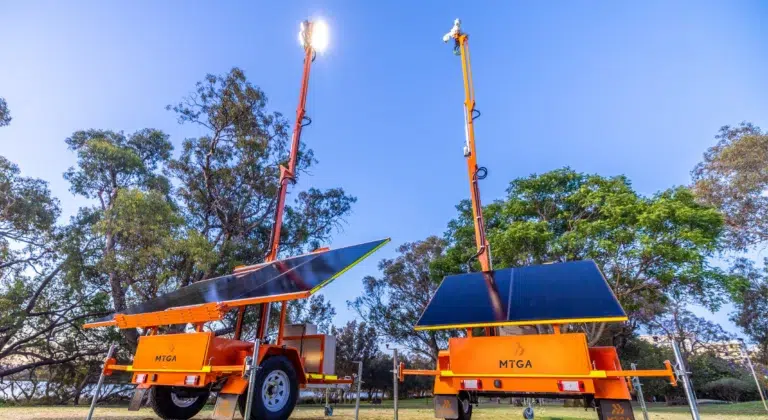
If you’re looking for diesel-free options, our off-grid lighting towers run on solar and battery power alone. They use no fuel, have no engine to service and produce no on-site exhaust. Our range comes in two build formats, forklift-moved Lux units and towable Omni trailers, with battery-only run-times of 45 to 65 hours.
| Lux 2 | Lux 4 | Omni 2 | Omni 4 | |
| Lumens | 29,400 | 58,800 | 29,400 | Up to 75,000 |
| Battery-only run-time | 45 hours | 45 hours | 45 hours | 65 hours |
| Solar panels | 2 x 415W | 4 x 415W | 2 x 415W | 3 x 415W |
| Mast | 6m telescopic | 6m telescopic | 8m electric | 8m electric |
| Wind rating (deployed) | 100 km/h | 100 km/h | 85 km/h | 85 km/h |
| How it moves | Forklift (concrete base) | Forklift (concrete base) | Towed (ADR compliant) | Towed (ADR compliant) |
| Availability | Purchase | Purchase | Purchase or hire through MTGA Hire | Purchase or hire through MTGA Hire |
| Best suited to | Single zones and access points | Larger open areas | Access points and smaller work areas | Large open areas and active work zones |
The Lux 2 solar lighting tower and Lux 4 solar lighting tower sit on a concrete base and are repositioned with a forklift, which suits compounds, laydown yards and other areas that stay put. Both are designed to run 14 hours a day through winter, and an astronomical clock switches the lights on at dusk and off at dawn without anyone on site to manage them. Each can be customised with extended battery reserve, a different mast height or extra lighting.
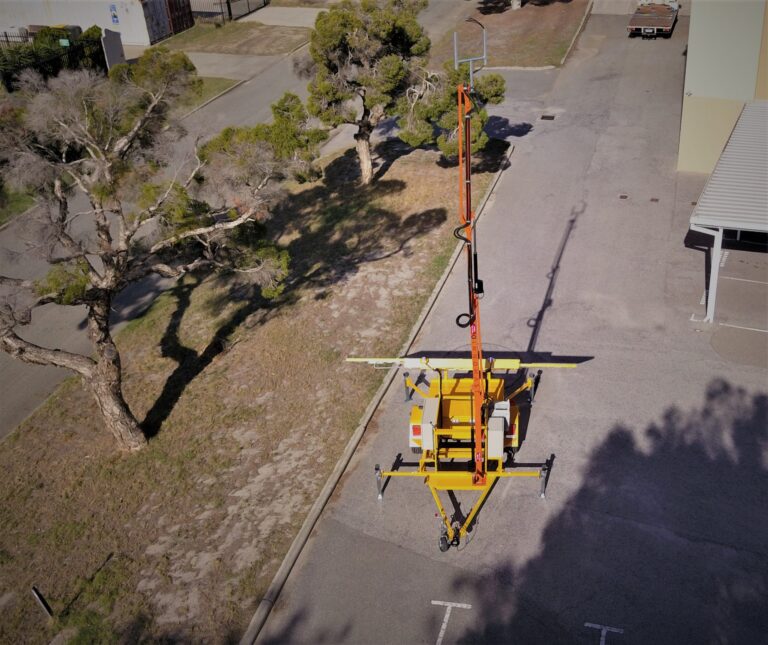
Meanwhile, our Omni lighting tower is built for work fronts that move. It tows into position behind a light vehicle, and its 8m electric mast extends at the push of a button. The Omni is also available through MTGA Hire for shutdowns, short projects and seasonal work, and for anything outside the standard hire range, our team can talk through the options.
What’s the best diesel-free lighting tower for a construction site?
The best diesel-free lighting tower for a construction site comes down to how much light the work needs, how long the tower must run without sun and how often it moves around the site. Solar towers eliminate fuel, engine servicing and exhaust, while diesel still offers higher output per unit. If you’d like help weighing these up for a project, our team can work through the lighting requirements with you.
Frequently Asked Questions
Are diesel-free lighting towers as bright as diesel ones?
Unit for unit, usually not. Many diesel LED towers produce more than 200,000 lumens, while solar towers typically produce well under that, with our own range running from 29,400 lumens up to 75,000. A diesel-free setup can still light a work area well when the output and number of towers are matched to the task.
How long do solar lighting towers run without sun?
Most solar lighting towers run for about 11 to 72 hours on battery alone, depending on battery size and light output. That ranges from less than one night to around six nights of 12-hour use. Our Lux and Omni towers run for 45 to 65 hours without any solar input.
Can you hire a diesel-free lighting tower in WA or elsewhere in Australia?
Yes. Diesel-free lighting towers are available from hire companies across Australia. You can hire a diesel-free lighting tower through MTGA Hire, which delivers the solar-powered Omni lighting trailer to sites anywhere in the country, including Western Australia (WA). Hire runs by the week, month or project, with maintenance handled by MTGA throughout.
Do diesel-free lighting towers cost more upfront than diesel?
Usually, yes. A new solar lighting tower typically costs around $19,000 to $43,000 excluding GST, compared with roughly $15,000 to $35,000 for a new diesel LED tower. Solar towers then avoid fuel and engine servicing costs, which narrows the difference over a long project.
Is a hybrid lighting tower better than pure solar for a construction site?
It depends on how critical the lighting is. A hybrid tower’s diesel generator takes over when the battery runs low, which suits sites that need full output every night regardless of weather. Pure solar suits sites with good sun exposure and predictable lighting needs, and it removes fuel and engine servicing entirely, which a hybrid can’t.