The first thing an approaching vehicle will see is not the boundary fence of your work site. The first thing it will see is the sign. When a live construction site borders heavy traffic, the sign becomes the difference between a controlled deceleration by approaching vehicles and an accident. VMS (Variable Message Sign) trailers are one of the most common forms of achieving high visibility and real-time signage on a construction site before a hazard comes into view for approaching vehicles. Businesses either have a range of VMS trailers purchased or rely on VMS trailer purchase; no matter where your business falls, the same regulations apply to traffic management.
What Does a Variable Message Sign Trailer Do?
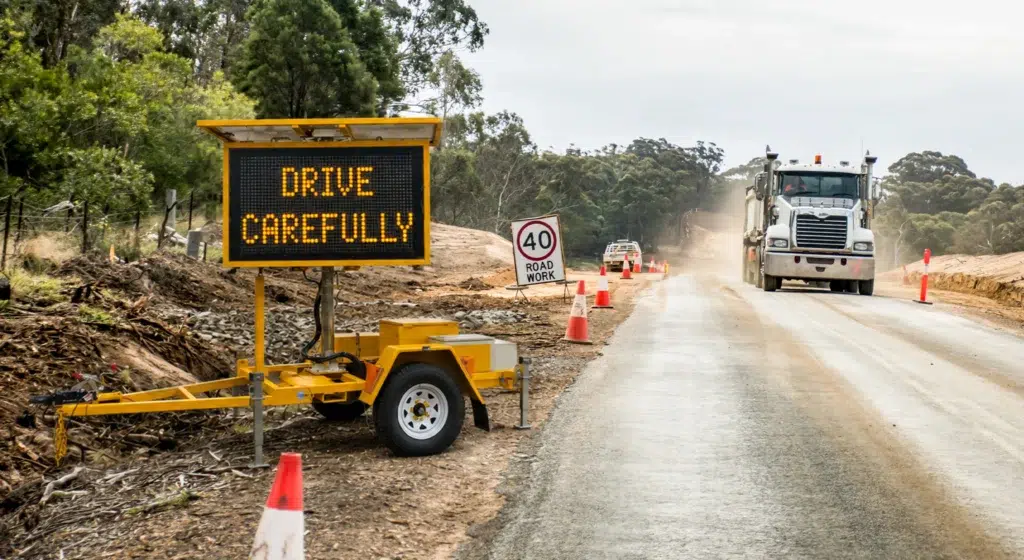
A variable message sign trailer is a towable unit with a solar power source and built-in battery storage which displays LED messages that provide information to road users as the situation demands. These signs may include lane closure information, detour information, reduced speed limit information, warning signs for an upcoming work zone, etc. The primary function of these signs is to give drivers advanced notification of potential hazards on the roadway. Therefore, drivers are able to take the necessary steps to reduce their speed and prepare themselves for any changes they will encounter prior to reaching the actual work area. In the event that a busy highway or high-speed corridor has been designated as part of the project route, the advance notification provided by these signs could prove critical to preventing accidents from occurring at the worksite.
Because modern VMS trailers have solar charging systems along with built-in battery banks, they require neither a power supply nor a generator. Additionally, because messages on a VMS trailer can be remotely changed using a mobile phone with 4G connectivity, remote updates can be made to existing signs without having to send someone to the roadside to make physical changes.
What standards govern VMS use?
There are a number of rules governing VMS use in Australia, but there are four types of regulations that apply to an employer’s workplace to take note of.
AS 4852.2:2019 Variable Message Signs, part 2. This is the main technical standard for portable Variable Message Signs placed on a relocatable trailer. AS 1742.3 and the Austroads Guide to Temporary Traffic Management. These two guidelines provide the framework as to how to set up temporary traffic management and utilise variable Message Signs at your work site.
In addition to these national standards, each state has added its own level of regulation to comply with. For example, Victoria regulates the messages allowed on portable Variable Message Signs and prohibits commercial advertising. Each state has their own specific regulations. While a sign may be compliant in one state, it does not mean that it will also be compliant in another. It is imperative to confirm compliance prior to deploying your Variable Message Signs.
Determining which board size is appropriate
Portable solar-powered VMS boards can be categorised into three different sizes depending on the speed limit of the area they are being installed in, and the viewing distance required based on AS 4852.2:
- Size A is suitable for low-speed urban streets, school zones & car parks
- Size B is designed for mid-speed zoning areas (up to 90 km/h)
- Size C is designed for high-speed zoning areas (above 90 km/h), where the reading distance is approximately 300m
The rules are pretty simple, the faster the traffic, the larger the board and character height you need for a driver to read the message in time. Under-sizing a board for a high-speed corridor does not just fail the standard, it fails the drivers you are trying to warn.
Where to Place the Trailer
The location of a compliant Variable Message Sign (VMS) is important for compliance. There are three key factors that determine this:
How far upstream the trailer sits. It must be positioned at a sufficient distance from the hazard so a driver can see all of the information contained within the sign and react appropriately prior to reaching the hazard. The farther above the posted speed limit a driver travels, the farther away from the hazard the trailer will need to be.
In relation to traffic flow. The side of the VMS that faces oncoming traffic is important. This ensures that when a driver views the message via LED lights, they have clean viewing as opposed to distorted/obscured viewing caused by the angle of the board to traffic.
Relative to the carriageway. The trailer should be located outside of the driving lane; beyond any protective measures required by the traffic management plan for the area; and with the solar panel facing south to receive maximum sunlight during the daylight hours while maintaining adequate shade from other objects or vehicles.
The exact placement of each trailer should comply with the approved traffic management plans for your specific project. However, these same principles apply regardless of which traffic management plan you are working under.
Why Choose a Ruggedised MTGA VMS Over a Cheaper Import?
Not every VMS trailer on the market is built to last. When you are evaluating options for a real worksite, especially in remote or off-road environments, the cheap imported alternatives often fail where it counts. Here is what separates a locally-engineered, ruggedised trailer from a liability:
- Solar power with real battery redundancy. A solar VMS board with only a day or two of reserve is a liability on a cloudy stretch. Four days or better is a much safer specification.
- 4G remote message management. The ability to update the message from a phone or web portal without dispatching a crew to the roadside is both a safety and a productivity gain. This is now standard on quality electronic message sign purchases.
- Ruggedised construction. Dust, UV, vibration and long hauls take a toll. Australian conditions are unkind to gear that was not designed for them, which is why a ruggedised VMS purchase Australia-built for local conditions holds up longer than an imported alternative.
- Fast deployment. A well-built unit can be positioned, levelled, raised and switched on by one person in a few minutes. Anything longer is eating your crew’s day.
- Local support. Locally engineered means locally supported. Parts, service and technical backup all matter when a unit is 800 kilometres from the workshop.
For an established piece of traffic management equipment, these criteria are what separate signs that hold up on a real project from those that do not.
The MTGA VMS Trailer
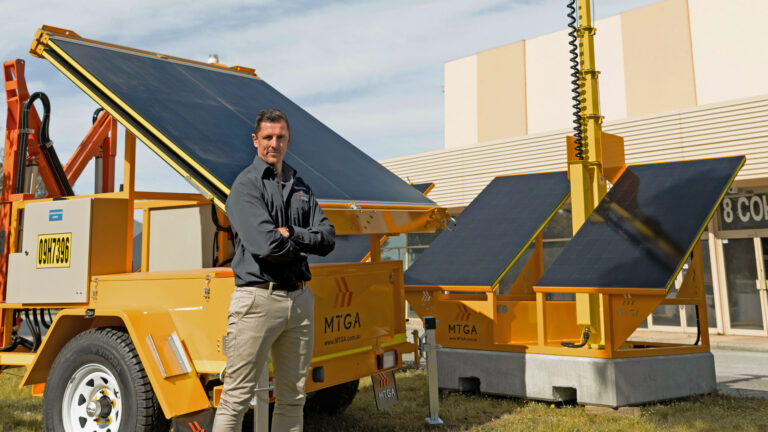
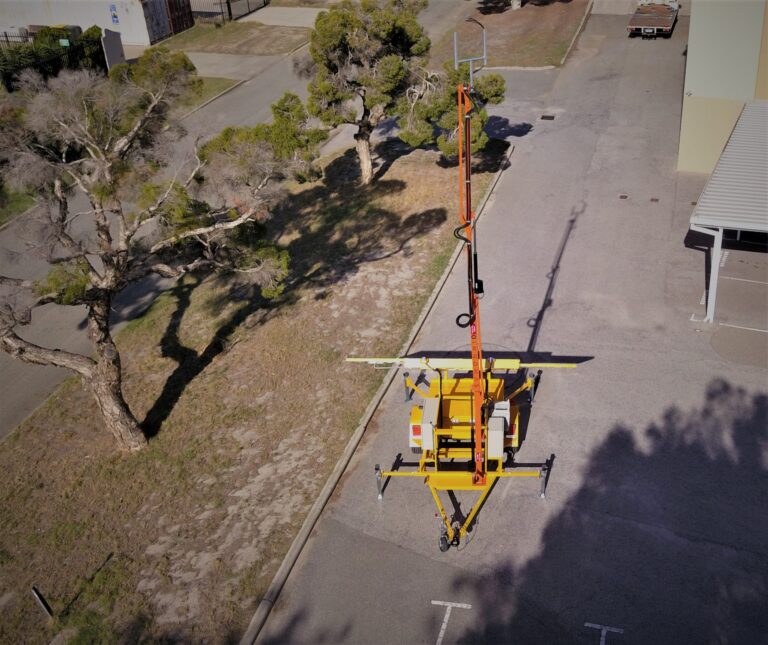
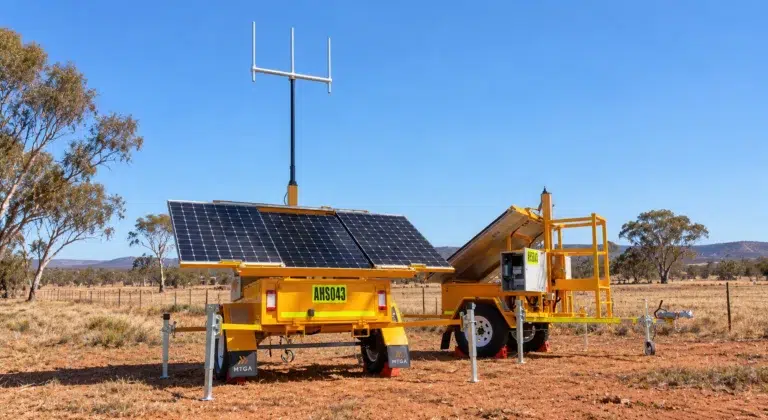
MTGA’s Variable Message Sign Trailer is designed and manufactured in Perth for the harsh and rugged Australian operating conditions. While cheaper imported VMS trailers struggle with dust, corrugation and extreme heat, the MTGA unit is engineered to survive remote site work and provide years of reliable service. It is built around the criteria above:
- 410W solar panel with 4 days of battery redundancy
- 5-colour LED display, 1.6 x 1 metre
- 4G and WiFi remote management from any device
- Electric height adjustment and manual swivel base for fast setup
- Forklift pockets and jackleg stabilisers for easy one-person deployment
- Optional integrated speed radar for active traffic management and speed awareness campaigns
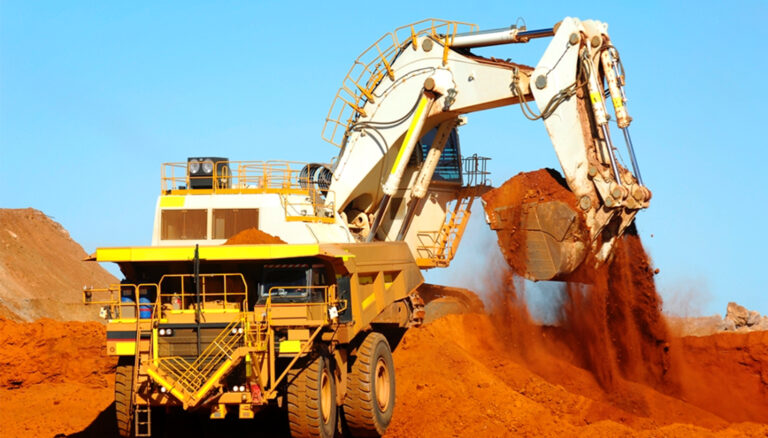
The unit is deployed across mining haul roads, civil construction sites and events, and can be tailored with speed radar, custom display configurations or a skid-mounted variant where a static installation is a better fit. Available for purchase.
For related reading, our guide to solar lighting trailers covers similar off-grid deployment principles for LED site lighting, and our Site Safety 101 guide walks through how site infrastructure layers together.
Talk to MTGA About VMS Trailer Purchase
If you have a live or upcoming project that needs a compliant, ruggedised VMS trailer, MTGA can put together a quote tailored to the site. Every unit is built in Perth and supported nationally.
Request a quote or explore MTGA’s civil construction industry solutions.
Frequently Asked Questions
What is a VMS trailer and how is it used in traffic management?
A variable message sign trailer (VMS) is a solar-powered, LED display that is used to convey important messages to the travelling public. These include: lane closures, detour information, reduced speed limits, worksite warnings and hazard alerts. When utilised in the construction and civil industries, VMS provide vital advanced notice of changes in road conditions allowing motorists to prepare themselves before reaching the works area.
How does a VMS Trailer improve safety at worksites?
One of the most successful methods of reducing accidents occurring at temporary worksites is providing clear, timely signage to motorists. This provides motorists with adequate opportunity to slow their vehicles prior to reaching the hazards posed by works.
The benefits of solar-powered VMS trailers
- Solar panels mounted on top of the unit charge a rechargeable battery bank, which then powers the LED screen throughout the day and into the evening.
- No external power source, such as a generator or main supply, is required. Messages can be programmed and changed remotely via 4G through either a website or mobile application.
- Features, including auto dimming assist in reducing glare, ensuring that the message displayed remains readable from dusk till dawn without dazzling the driver.
What Australian standards apply to VMS at roadworks?
AS 4852.2-2019 defines the minimum requirements for all portable variable Message signage systems when it comes to traffic management equipment. As this includes signage located on a relocatable trailer, it will dictate compliance with the use of all portable Variable Message Signage. How these types of units are applied during a worksite will comply with AS 1742.3 & Austroads Guide to Temporary Traffic Management (AGTTM). Each state has additional regulations relating to portable Variable Message signage, and each will have its own set of rules.
For example, the Victorian government requires a pre-approved Message list to be adhered to when using portable VMS units. They also prohibit commercial advertising on all portable VMS units. Please contact your relevant state road authority for further information regarding regulations specific to your location.
How large should my VMS board be to display important safety information to motorists?
In accordance with AS 4852.2, there are three different sizes of portable displays available based on the expected speeds and viewing distances encountered along our roads. The smallest display (Size A) would typically be suitable for low-speed urban streets & school zones. Mid-speed areas (between 60 km/hr & 90 km/hr) would require Size B displays. High-speed areas (over 90 km/hr) would require Size C displays.