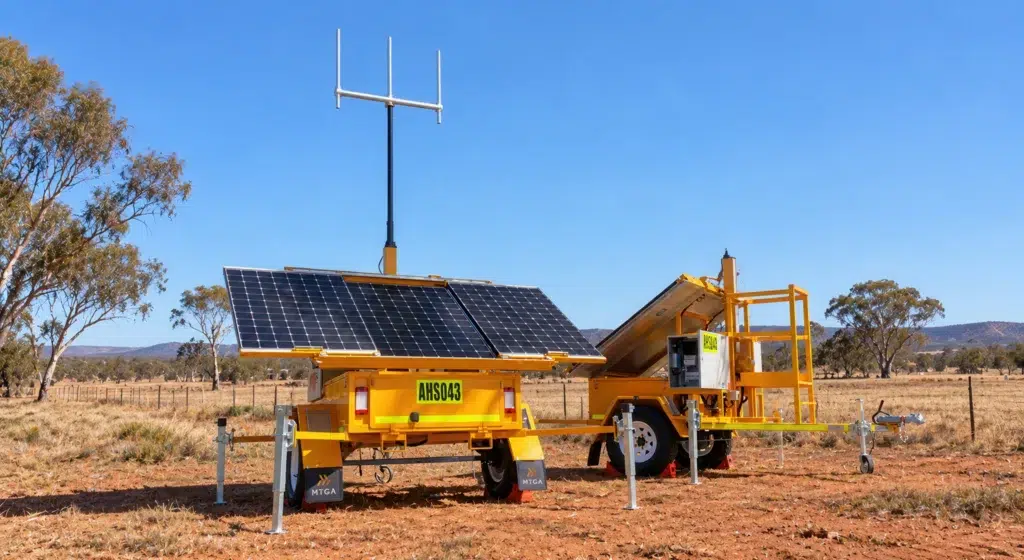
Keeping a repeater or camera running at the far end of your property usually means keeping a diesel generator running too. That generator needs refuelling, servicing and regular checks, and each of those is a separate trip. If it runs dry or breaks down between visits, the equipment it powers stays offline until someone can get out to it.
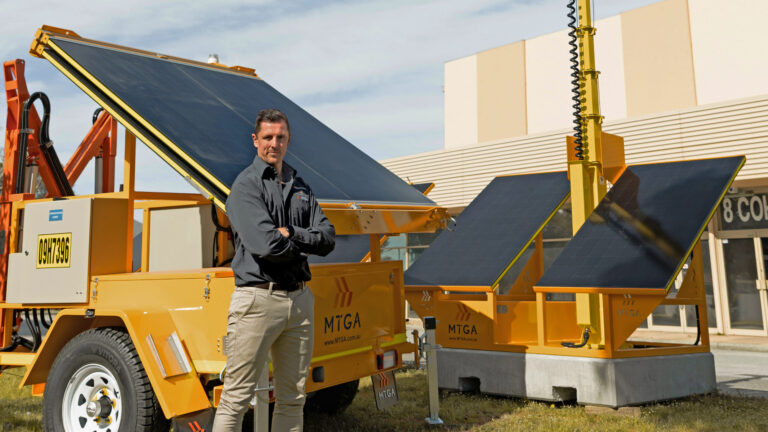
Off-grid solar power for farms removes those trips for low-power equipment like this. Mobile solar units carry their own panels and lithium batteries, run without mains power or fuel, and can be moved wherever you need them next.
Why Diesel Still Dominates Farm Power
According to AgriFutures Australia, diesel made up 84% of total energy use across agriculture, fisheries and forestry in 2020–21. Most of that goes into machinery, where diesel has no practical replacement yet.
Generators running remote equipment are a different case. A repeater or light tower draws a few hundred watts at most, around a tenth of what an electric kettle uses, but the generator powering it still needs the same fuel runs and servicing as one running a much bigger load. Those small generators are where solar is already a workable alternative to diesel.
Fixed Off-Grid Solar vs Mobile Solar Power for Farms
A mobile solar generator and a fixed off-grid system solve different problems. Fixed off-grid solar power for farms is designed around buildings such as the homestead, sheds and workshops. It doesn’t reach equipment out in the paddocks or at seasonal sites.
| Fixed off-grid solar | Mobile solar trailers | |
| Location | Homestead, sheds, workshops | Paddocks, camps, storage areas |
| What it powers | Buildings and their appliances | One dedicated load: comms, cameras or lighting |
| Setup | Installed on site | Towed or forklifted into position |
| Relocation | Stays put | Moves with the work |
| Backup and storage | Battery bank installed with the system | Onboard lithium batteries. For standard outlets, battery power trailers carry 43.2kWh, charged from a three-phase supply |
| Best for | Permanent power needs | Remote or seasonal infrastructure |
Mobile units work for remote equipment because the load is small and steady, so a trailer’s panels and batteries can be matched to it, with enough battery capacity to keep running through a few days of overcast weather. Getting mains power to the same spot would mean running cable over long distances, for equipment that may need to move next season.
If you’re powering a workshop or cool room with large, constant loads, a fixed system is still better. The two can also work side by side: a fixed system for the buildings, and mobile units for everything beyond them.
Powering Remote Farm Connectivity and Communications
In one GRDC project, about 95% of a 2,000-hectare cropping farm in the WA Wheatbelt had no consistent coverage from Telstra, Optus or Vodafone. A 15,000-hectare farm in northern NSW, within the same project, had no existing coverage across about 85% of its area. On the Wheatbelt property, patchy coverage limited how far the farm could adopt precision ag and autonomous machinery.
On broadacre properties like these, there’s often a signal somewhere, even if it only reaches a small part of the farm. Solar-powered communications trailers and base stations pick up that signal and extend it to where it’s missing. Because each unit carries its own solar panels and batteries, you can place it wherever the gap is, with no power supply needed at that spot.
Since it extends an existing signal, each unit still needs a source to connect to, such as a mobile tower within range, a link back to the homestead’s internet, or a satellite service. The radios on board can be matched to the network you already use, whether that’s 4G or Wi-Fi.
Farm Communications Solutions Across the Property
Where a unit goes depends on what needs to stay connected.
- Paddock repeaters: extend coverage across cropping country, providing the agtech connectivity that connected machinery and in-paddock sensors rely on.
- Harvest coverage: a trailer positioned near the paddocks being harvested, relocated as harvest moves across the property.
- Camera links: a relay point for cameras at fuel, grain or machinery storage areas.
- Long-term coverage: where the need is permanent, a base station provides a fixed anchor point for the property’s network.
Seasonal and Temporary Power for Farm Operations
Seeding, harvest and shearing all create short-term power and coverage needs in parts of your property that don’t normally have either. Solar power trailers for agriculture suit this kind of work because they can be towed in for the season and moved on afterwards, with nothing to install and no fuel to manage.
Seasonal uses include:
- Seeding and harvest: lighting for night work, refuelling points and machinery maintenance.
- Shearing: lighting and coverage around the shed, yards and shearers’ quarters. The trailers support the site, not the shearing plant itself, which draws more power than a solar trailer supplies.
- Remote camps: lighting and connectivity for contractors or seasonal workers staying out on the property.
- Grain storage: lighting and cameras around silos and storage areas while grain is being moved.
For seasonal lighting, the two figures to check are run time per night and battery backup. MTGA’s mobile solar-powered lighting towers, for example, run 12 to 14 hours a night through winter and carry five days of battery backup, which covers a long night shift and a run of cloudy days.
Security and Monitoring Without Mains Power
A standard security camera needs power wherever it’s mounted. That’s easy around the homestead, but the parts of your property most worth watching, like fuel and machinery storage, often sit well away from mains power.
Solar CCTV units get around this by carrying their own panels and batteries, so you can put them wherever you need a camera. They record onboard and stream live over 4G when there’s coverage, so you still have the footage even if the signal drops out.
For open areas and longer periods, solar CCTV and surveillance trailers can run for up to five days on battery alone. For gates or tight spaces where a trailer won’t fit, a compact skid like MTGA’s Protect 1 goes in by forklift and runs for 48 hours on battery alone. Both are recording within minutes of being set up.
If you’re weighing up your options, read our guide to CCTV hire for agriculture.
Hire vs Buy: Trialling Solar Power Before You Commit
Some needs on your property only last a season, and it isn’t always clear upfront if a unit will do the job in the spot you have in mind. Hiring lets you try off-grid solar power for farms on your own property before you spend. You could hire a solar power trailer for harvest, see how the coverage holds up across your paddocks, then decide if it’s worth owning.
MTGA’s hire range includes its comms, CCTV and lighting trailers and the Protect 1 skid, delivered Australia-wide, including to remote properties. Units arrive pre-configured and ready to use, and the hire cost covers delivery, routine maintenance and support for the length of the hire.
If you already know you’ll need it year-round, or want it set up specifically for your property, then owning the unit is the way to go.
| Hire | Buy | |
| Upfront cost | No capital outlay | Full purchase price |
| Maintenance | Covered by MTGA during the hire | Yours, with MTGA support available |
| Flexibility | By the week, month or project, with no fixed minimum | Yours to deploy, and configurations can be tailored |
| Best for | Seasonal work, trials, short-term gaps | Year-round or permanent needs |
Rebates and Support Available to Farmers
If you’re buying connectivity equipment, check first whether a rebate can cover part of the cost. The Australian Government’s On Farm Connectivity Program has run over three rounds so far. Its most recent round offered rebates of up to $20,000 (GST exclusive), covering up to 50% of the price of eligible on-farm connectivity equipment. Funding is released in rounds, so check the program page to see whether one is open before you buy.
The rebate works through suppliers. You buy from one of the program’s Approved Suppliers, who lodges the application, takes up to half off the eligible price and claims the rebate. It covers purchases of eligible connectivity equipment, not general power hire. There are eligibility rules for farmers, including ABN and income requirements, so read the guidelines before you go ahead. If you’re in WA, DPIRD may also offer state-level support. Elsewhere, your state agriculture department is the place to ask.
Talk to MTGA About Your Property
If you’ve got equipment past the homestead still running on a generator, or parts of your property with no coverage at all, our team can help you work out what fits, whether that’s a unit for the season or a long-term setup. Tell us about your property and what you need running out there, and we’ll work through the options with you.
Get a quote for hire or purchase.
Frequently Asked Questions
What is a solar power trailer and what can it run?
A solar power trailer is a towable unit with its own solar panels and battery storage, built to run equipment where there’s no mains power. On farms, each one typically runs a single dedicated job, such as communications, CCTV or lighting. They aren’t designed for heavy loads like a shearing plant or workshop machinery. For standard power outlets, a battery power trailer charged from a three-phase supply is a separate option.
How do I power a repeater, Wi-Fi node or camera where there is no mains power?
Use a solar-powered unit that carries its own panels and batteries. Repeaters, Wi-Fi nodes and cameras draw a small, steady amount of power, so a solar trailer or skid can be matched to the load and keep running through a few days of cloudy weather on battery alone. That avoids running cable from the homestead or relying on a diesel generator that needs regular fuel runs.
Can a communications trailer provide coverage during harvest?
Yes. A solar communications trailer can be positioned near the paddocks being harvested and moved as the work progresses across the property. It extends signal from an existing source, such as a mobile tower within range, the homestead’s internet or a satellite service, so it needs one of those to connect to. It can’t create coverage where there’s no source at all.
Should I hire or buy a solar power trailer for seasonal farm work?
Hire suits work that only lasts a season, such as harvest or shearing, or when you want to test a unit on your property before committing. MTGA’s hire cost covers delivery, routine maintenance and support for the length of the hire. If you’ll need the unit year-round or want it configured specifically for your property, buying is usually the better choice.
Are there rebates or grants for off-grid solar or connectivity equipment on farms?
For connectivity equipment, there’s the Australian Government’s On Farm Connectivity Program 2026. It has run over three rounds, and its most recent round offered rebates of up to $20,000 (GST exclusive), covering up to 50% of the price of eligible on-farm connectivity equipment. Purchases go through an Approved Supplier, who lodges the application, and the rebate doesn’t cover general power hire. Funding is released in rounds, so check the program page to see whether one is open, and wait for approval before you order. WA producers can also ask DPIRD about state-level support.
How quickly can a solar power trailer be deployed and relocated between paddocks?
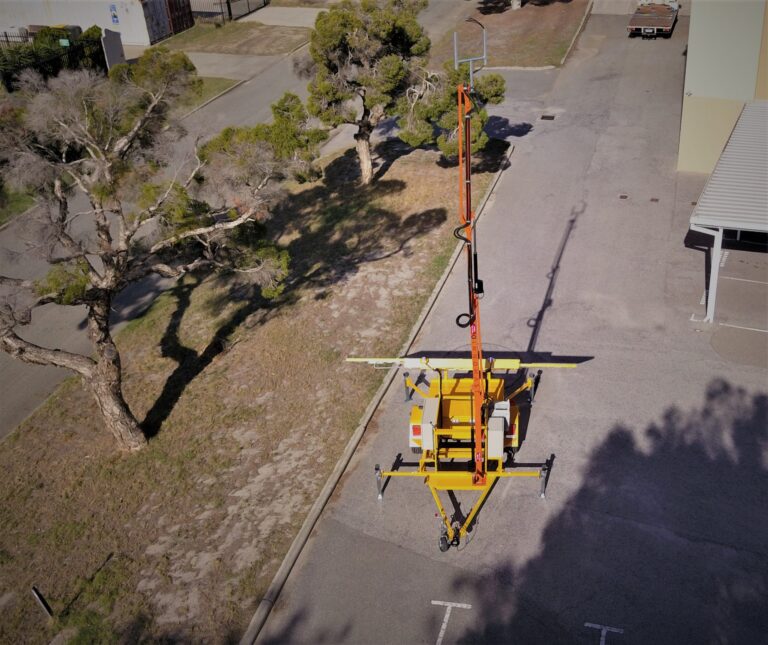
MTGA’s trailers are set up by towing them into position, extending the mast and switching them on, with no cabling or installation needed. Its solar CCTV units are recording within minutes of being set up. Moving one between paddocks is the same process in reverse, so units can follow the work as your needs change.